Posts Tagged ‘Wine’

Do taste and smell adjectives signal value, or do they create it?

Thursday, July 2nd, 2009

We may disagree about our favorite artists and musicians, but it’s relatively easy to agree that a particular color is blue, or that a particular note is C-sharp. They’re described by wavelengths and frequencies along a clearly defined spectrum. That’s why the technologies of visual and auditory reproduction—photo, video, audio—work so well, relatively speaking.

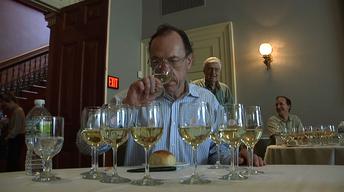
Worth a thousand words?

Worth a thousand words?

With taste and smell—the so-called “chemical” senses, which are more complex (humans have about 400 different types of olfactory receptors) and less well understood than the others, we don’t have the luxury of those points of reference. That’s why we so often resort to loose analogies—“tastes like chicken”—and it’s also why reproducing tastes and smells is so difficult (grape soda doesn’t taste much like grapes, and nobody’s yet synthesized a bottle of 1945 Pétrus—an activity that would surely yield tremendous profit).

To challenge this barrier, we resort to analogy. Coffee tastes like nuts and chocolate; Sauvignon Blanc smells like grapefruit and cat pee. In a Sauternes, you might sense the brine of the first green olive you tasted in Italy; in a Pedro Ximénez sherry, the viscous maple syrup that your grandmother once drizzled on your pancakes.

But how carefully are we really choosing these adjectives and analogies? (more…)

In Sweden, all wine stores are organized by price

Wednesday, June 17th, 2009

Sweden has one of the world’s most controlled alcohol regimes, with steep taxation, a state-controlled retail monopoly, and a 20-year-old minimum age to buy alcohol at a store (and they really card, too). The only store at which a consumer can buy wine, beer, or liquor in Sweden is Systembolaget, the state-controlled retail monopoly.

Is this a good thing or a bad thing? My intuition (and that of the economists I’ve been speaking with here in Stockholm) is the latter—first and foremost, as in Quebec, it’s a major headache for wine producers, whose distribution chances hang on the (often arbitrary) whims of just one decisionmaker. Opening hours of stores are criminally short. Pricing is screwy, in part because per-unit (rather than per-krona) taxation results in cheap wine being overpriced and expensive wine underpriced. As ever, monopolies throw everybody’s incentives out of whack.

sweden-wine-1sweden-wine-21

sweden-wine-3

But here’s one definite consumer-oriented boon that results: in an of-the-people move, Systembolaget wine stores—that is, all wine stores in Sweden—are organized first by color, second by price. There’s the 69-kronor-(US$8.71)-and-under red wine section; there’s the 70-kronor-(US$8.84)-to-99-kronor (US$12.50) red wine section; and then there’s the 100-kronor (US$12.63)-and-up red wine section.

Although I’ve seen US wine stores with special $10-and-under sections and such, I’ve never seen an entire store organized this way. Intuitively, at least, it seems to be more aligned with consumers’ game plans as organization by region, grape, and so forth.

Why don’t non-monopoly stores organize this way?

My guess would be that profit-minded stores, for understandable reasons, don’t want to lose the chance to upsell—they want people to walk away with a wine more expensive than the one they came looking for.

Talk at Spain’s FENAVIN: “Critics for sale? Blind Tasting and the Honest Wine Movement”

Monday, April 27th, 2009

fenavinAt FENAVIN, the Spanish wine industry fair, in Ciudad Real on May 15 (blog entry at Aprende a Catar Vino (Spanish); articles about the talk at El Día del Ciudad Real, Cava ArgentinaLa Comarca de Puertollano, and Vendimia), I will talk talked to the Spanish wine industry on the following topics:

1. Are most wine critics impartial judges of quality, or are they really serving as public-relations advocates on behalf of producers? With evidence from my own empirical work, expository journalism, and a survey of the industry, I argue that most wine critics are really in the business of advertising wine, not judging it impartially. Critics are for sale. (more…)